 Denmark, Finland, & the Faroe Islands
No Dish Left Unthrown: Denmark’s Unique Way of Saying ‘Happy New Years!’
On New Year’s Eve in the United States, you might hear fireworks, church bells, or even rowdy neighbors celebrating like it’s 1999. In Denmark, however, the night is marked by a different sound: porcelain meeting stone. Across the country, people step outside carrying bags of old plates, and at the stroke of midnight, they hurl them at the doors of their friends and neighbors. While it may look like chaos, in true Nordic fashion, it’s a well-organized ritual—full of meaning, rules, and just enough danger to keep things interesting.
The tradition stems from old folk beliefs that noise could chase away bad luck and lingering spirits from the past year. If you frightened the bad things away before the new year arrived, good fortune might be more willing to move in. Over time, the spiritual meaning faded, but the noise endured. Danes, who originally used drums and bells for this purpose, eventually replaced them with whatever chipped dishes were already living at the back of the cupboard.

The best part is that the mess is considered a compliment. If you wake up on New Year’s Day to find your front step covered in shattered plates, it means you’re doing well socially. Your friends took the time to remember you while cleaning out their kitchens. A spotless doorstep on January 1st isn’t a sign of good housekeeping—it’s a sign you may need to work on your friendships.
There’s also something delightfully practical about the whole tradition. Scandinavians aren’t known for wasting things, and this is a creative solution for dishes no longer fit for polite company. The plates have served their purpose, carrying food through family dinners and quiet evenings, and now they’re given one final, dramatic moment before retirement. Even in celebration, there’s a sense of thrift and purpose.
As a storyteller, I love this tradition because it captures Denmark in a single, resounding moment. Friendship is valued. Community is loud and visible. Luck is something you can help along with a little effort and a strong throwing arm. If you’re going to start a new year, you might as well begin by breaking something together—and laughing about it the next morning.
His daily supply of beer would have made Andre the Giant happy.
Nobel Prize–winning physicist Niels Bohr didn’t just change the way we understand atoms—he also had the best beer delivery system in the history of mankind. See, back in 1932, the fine folks at the Carlsberg Brewery decided to thank Bohr for all that brain work by giving him a lifetime supply of beer. And they weren’t messing around. His house was literally next door to the brewery and, because Denmark is apparently run by beer-loving geniuses, they ran a pipe from the brewery straight into his house. Not kidding. This man had a beer tap in his wall like it was just another utility—gas, water, electricity, beer.
Now, here’s where it gets good.
When Carlsberg asked how much beer he’d like delivered each day, Bohr—being a modest Scandinavian fellow—said, “Twelve.” Meaning twelve bottles. But whoever was taking notes either misheard him or was feeling particularly festive, and they started sending him twelve crates a day. That’s 144 bottles, every single day. That’s not a beer supply—that’s a fraternity kegger with a physics degree.
So there sat one of the smartest men on Earth, surrounded by enough beer to hydrate a small village, probably wondering if he should drink it, share it, or open a bar. Eventually, someone caught the error and scaled it back, but by then the legend had taken root: Niels Bohr, the atomic pioneer with a beer tap in his house and a twelve-crate-a-day habit (that he probably didn’t even want).
Moral of the story? Even brilliant minds get misunderstood. And sometimes, just sometimes, the universe answers your accomplishments not with applause—but with a direct line to cold beer.

The Trial of Fire brought Christianity to Scandinavia.
“The Trial of Fire”
Court of King Harald Bluetooth, Denmark – Year of our Lord 970
Smoke hung low over the timbered hall, thick with the scent of pine tar and the faint metallic tang of blood. Warriors sat shoulder to shoulder on long benches, their eyes reflecting the flicker of firelight. Shields lined the walls, their painted faces seeming to watch the proceedings like silent judges. At the head of the hall, upon a carved high seat, sat King Harald Bluetooth—his beard braided, his eyes like ice over still water.
It was a day unlike others, for in the heart of this pagan court, the gods of Asgard were being called into question.
“Let the gods speak,” Harald had declared days before, raising his voice above the murmurs of his jarls. “Let it be seen—whether it is Thor who guards us, or this Christ the priest speaks of.”
The man he spoke of was Bishop Poppo, a missionary from the German lands, clad in a rough wool robe, a silver cross hanging from his neck. He had stood quietly at the king’s words, neither flinching nor smiling.
“I submit myself,” he had said calmly, “to the judgment of God.”
And so the trial was set: the Ordeal of Iron.
They came to the square at dawn. The second bronze would later capture this moment—iron glowing red-hot above roaring flames, held aloft by blacksmiths whose eyes darted uneasily between the weapon and the sky.
Poppo stood barefoot on the frozen earth, murmuring a prayer in Latin as the rod was placed in his hands. The crowd watched in breathless silence as he walked forward, step by step, the skin of his palms hissing with the heat of the metal. He dropped it only when the count was met, his face serene even as the flesh of his hands smoked.
Then came the gloves—thick and linen-wrapped, like oven mitts. They bound them over his hands, sealing the wound away from the world.
“For four nights he will wait,” Harald announced to the hushed court. “And then we will see which god has heard his prayer.”
On the fourth day, the king himself called for Poppo. The people pressed close as the bishop knelt, silent. Harald stepped forward with rough hands and unwrapped the cloth.
A hush fell over the court.
The skin beneath was whole. Clean. Untouched by burn or rot.
Even Harald’s stern face wavered with disbelief.
“Is this your sorcery?” a priest of Odin snarled. But no one spoke in agreement.
“I walked through the fire,” Poppo said softly, “and the Lord walked with me.”
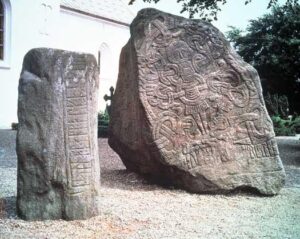
In the final bronze, carved centuries later, Harald stands waist-deep in a barrel of water, stripped of the old gods as the bishop pours water over his head. It is a solemn act, but the moment ripples like thunder across the lands of the north.
Though many still clung to Thor’s hammer and Odin’s wisdom, the king’s baptism marked a beginning.
Not an end—but a turning.
Christianity had come to Scandinavia, not with armies, but with fire.
And the gods had watched it all in silence.
“I submit myself,” he had said calmly, “to the judgment of God.”
And so the trial was set: the Ordeal of Iron.